Category Archives: In the news

Laura, Nicholas Green’s sister’s wedding. An interview with his father, Reginald: “He continues to save lives today thanks to organ donation”

“Here is a slightly shortened version of an online article in Oggi, the most widely read of Italy’s weekly news magazines. (Reg Green)

Article by Deborah Ameri

We interviewed the father of the American child who, almost 30 years ago, was murdered by two robbers and who, thanks to the gesture of his parents, has stimulated transplants in our country. His sister Laura, born twenty months after the tragedy, has just got married in Washington, remembers her little brother.
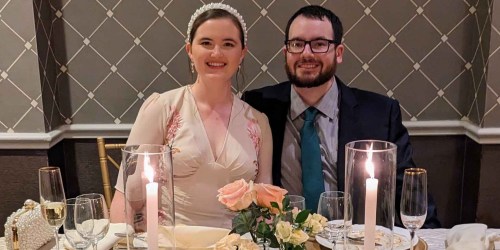
Laura and Ethan

Laura Green and Ethan Sennett wed in Alexandria, Virginia, USA

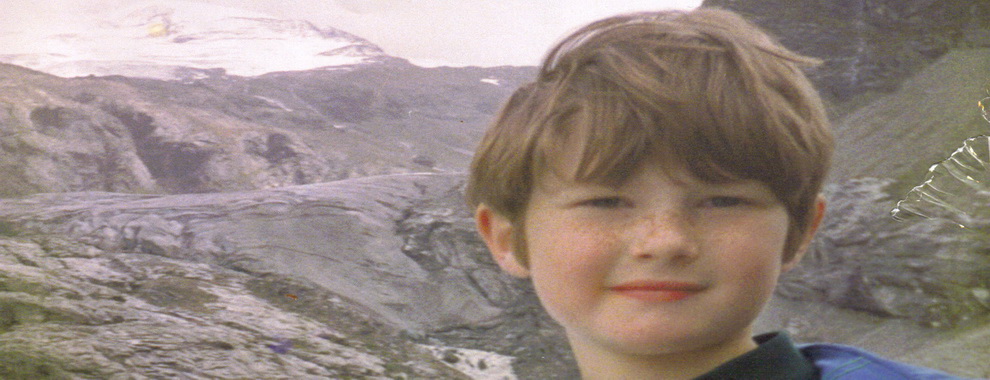
Reginald Green is 94 years old, an American, a former journalist and writer. He has a wife, Maggie, 30 years his junior, three children, Eleanor, Laura and Martin. And a fourth, killed in 1994, who was only 7 years old, by two robbers on the Salerno-Reggio Calabria motorway, during a vacation in Italy.
That child was Nicholas Green, who donated his organs to seven seriously ill people when he died: a gesture that at the time seemed revolutionary, even incomprehensible. This is why the story of the Greens is known all over the world.
Almost 30 years have passed since Nicholas’ death but he continues to save lives, Reg tells us, connected via Zoom from Alexandria, near Washington, where Laura got married yesterday. She was born twenty months after the tragedy (together with her twin Martin).

Mr. Green, Since that day you have been committed to promoting the culture of organ donation. And it continues to this day. Why?

“After my son’s death there was what was then called the Nicholas Effect. Organ donations in Italy tripled in a few years bringing it to the top places for transplants in Europe and in the world, while before it was at the bottom [in Europe.] Nicholas saved not only the original seven recipients, but thousands of lives and continues to do so in death, also thanks to the book I wrote and the film, Nicholas’ Gift which was based on it, seen by a hundred million people”.

Did you ever think about it before that tragic day?
“No, Maggie and I never talked about it. But when we saw him on the last day, we knew we couldn’t bring him back. He no longer needed those organs.”

Was it a hard-fought decision?
“No. The doctors told us he was brain dead. We asked several times, are you sure? My wife and I sat holding hands in silence. Then Maggie said: ‘He’s gone. We should donate organs.’ And for the first time in that hopeless situation, I saw a glimmer of positivity.”

Laura and Martin were born almost two years after the tragedy. When did you tell them about their little brother?
“As soon as they were old enough to understand we always talked about Nicholas. Not in a forced way, but in conversations……. ; They have never been frightened by his death.’

Laura, 27, has just gotten married to Ethan Sennett. Was Nicholas remembered at the ceremony?
“Yes, I mentioned it in my speech. It wouldn’t have been a family celebration without him, who was there in spirit. Eleanor, my daughter who was in the car with us at the time of the tragedy, was married at the Bell Tower (a memorial to the slain child, made up of 140 bells in Bodega Bay, California, ed ), because she wanted to have her brother at her wedding. Incidentally, Eleanor is pregnant and my fifth grandchild will be born in September.’
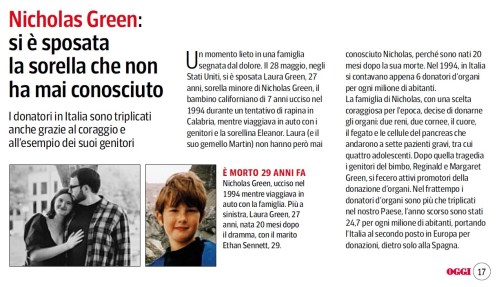
OGGI article in the print edition

OGGI article in the print edition (June 2023)

You have often returned to Italy. Don’t you feel resentment towards our country?
“….. I have come fifty times. And no, we feel no resentment. It could have happened anywhere. All the people we met would have done anything to save Nicholas and to prevent the tragedy”.

Has there ever been anything in these years that made you angry?
“You are the kindest people in the world. Wherever I go, I get warmth and understanding, everyone knows our son. Nicholas has millions of uncles and aunts in Italy. I know that even in schools they talk about him. It was not Italy that fired the gun, but two criminals”.

Have you ever met the people who received your son’s organs?
“Certainly. Last October I saw Francesco Mondello and Domenica Galletta who received corneas. I am in contact with Maria Pia Pedalà who received his liver. Today you could not tell that she has been ill. Her firstborn is called Nicholas.”

In Italy there are more than one hundred and twenty places with the name of Nicholas: streets, parks, squares, schools. Why did your story touch people’s hearts so much?
“Our son was not just an innocent child killed for no reason. He is something bigger. The symbol of organ donation, but also the symbol of giving. And the demonstration that, even in a terrible situation, something good can be done”.

Nicholas saved so many lives. Does that ease his pain at least a little?
“I think of him every day, but knowing that even in death he continues to help others is a great consolation to me”.

Deborah Ameri

Link to the original article online:
https://www.oggi.it/attualita/notizie/2023/05/29/laura-il-matrimonio-della-sorella-di-nicholas-green-lintervista-a-papa-reginald-continua-a-salvare-vite-ancora-oggi-grazie-alla-donazione-degli-organi/ 


1 Comment

Filed under Events, In the news, Nicholas' story

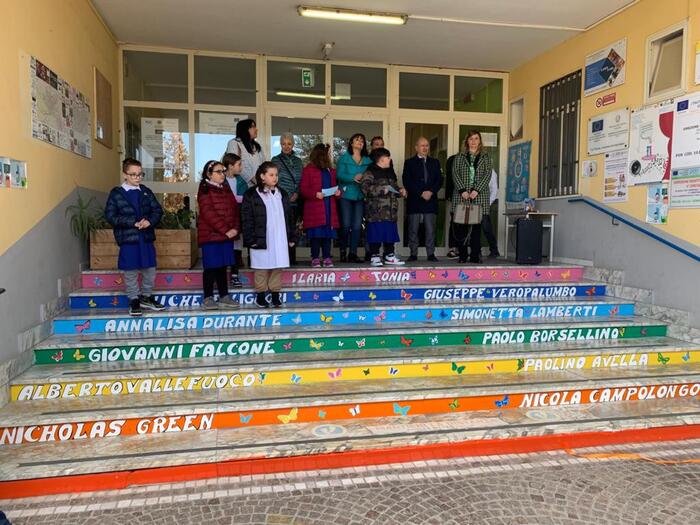
Stairway of Lawfulness

A primary school in Acerra, Italy, near Naples, has written, in large letters and on a background of bold colors, the names of victims of the Mafia on its front steps — including judges who knowingly put their lives at risk — so that every day the students will be forcibly reminded of the importance of combating lawlessness with justice.

On the first step, among all the Italian names, one is American: Nicholas Green. 

Stairway - Italian school

Photo by ‘Ansa’ press agency, Italy

Link to Ansa article: https://www.ansa.it/campania/notizie/comune_di_acerra/2023/03/21/inaugurata-scala-legalita-al-iv-circolo-didattico_605bddc1-da82-4502-b9d0-0b816b23ab6e.html

Leave a comment

Filed under Events, In the news, Italia, Italy, Nicholas' story

BBC News. Organ donation: ‘My daughter was shot but lives on in those she saved’

By Harry Low (BBC News reporter)

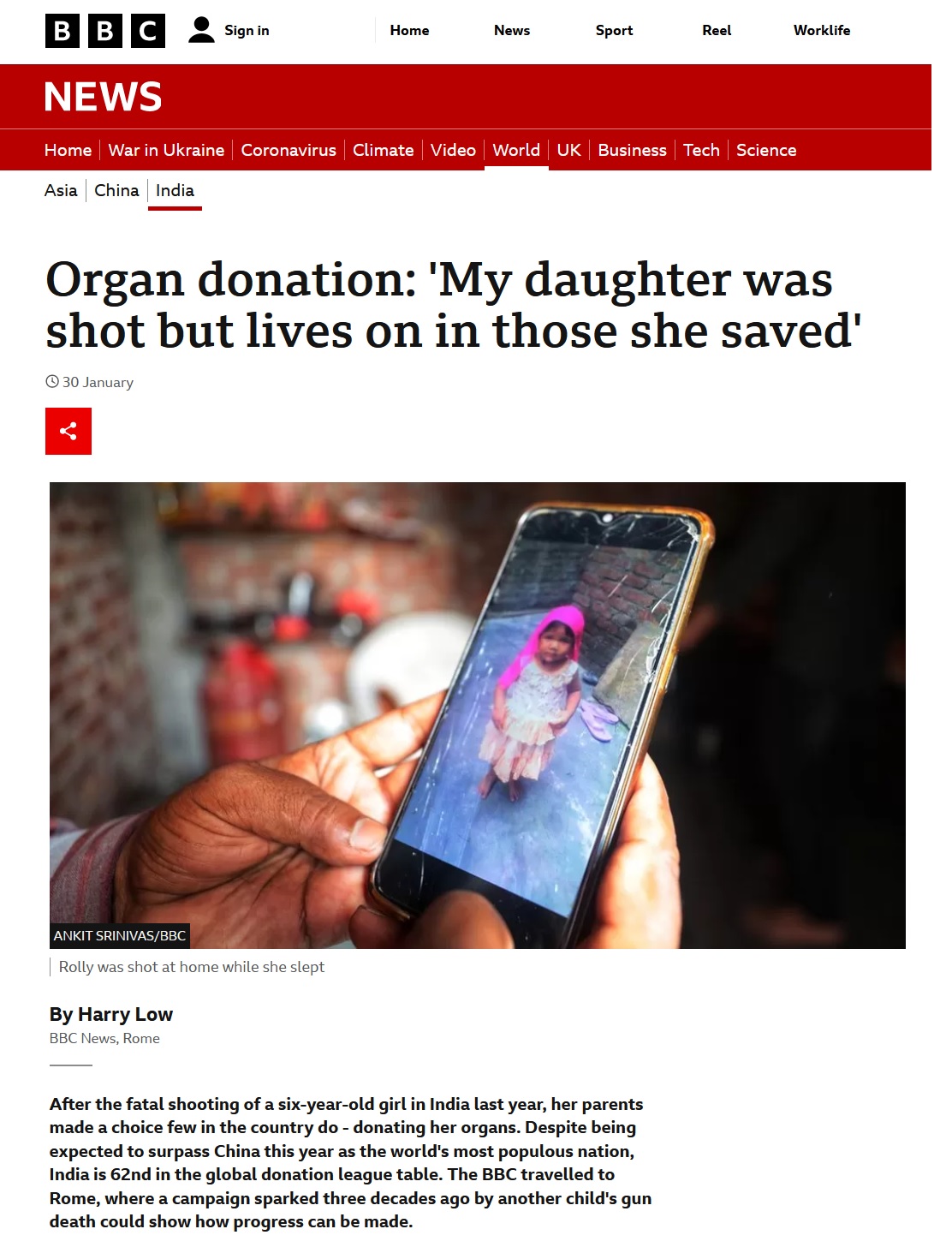
After the fatal shooting of a six-year-old girl in India last year, her parents made a choice few in the country do – donating her organs. Despite being expected to surpass China this year as the world’s most populous nation, India is 62nd in the global donation league table. The BBC travelled to Rome, where a campaign sparked three decades ago by another child’s gun death could show how progress can be made.

Link to the complete article: https://www.bbc.com/news/world-asia-india-62987703

BBC Article - Harry Low - January 2023

Rolly Prajapati was sleeping peacefully last April in the home she shared with her five brothers and sisters in suburban Delhi. In the next room, her parents were preparing dinner when they heard a loud bang and a scream.

When they went into the room, Rolly cried out for her parents before falling unconscious. […..]

After days of agonising, her parents made a decision few in India have done before: to donate her organs. Rolly became the youngest donor at the All India Institute of Medical Sciences (AIIMS) in New Delhi. […..]

“Eventually we decided to go ahead, thinking ‘if my daughter’s organs could save someone’s life, then we should do it’. “We think that our daughter is alive inside the young recipients – our daughter will live on this way.”

Both of Rolly’s kidneys were transplanted to Dev Upadhyaya, 14, whose parents told the BBC it was “a miracle to us” that he received the organs. They had been waiting four years for a transplant and said their “life has been changed” because Rolly’s kidneys had “given new life” to Dev. […..]

Rolly’s death has parallels with the story of Nicholas Green.

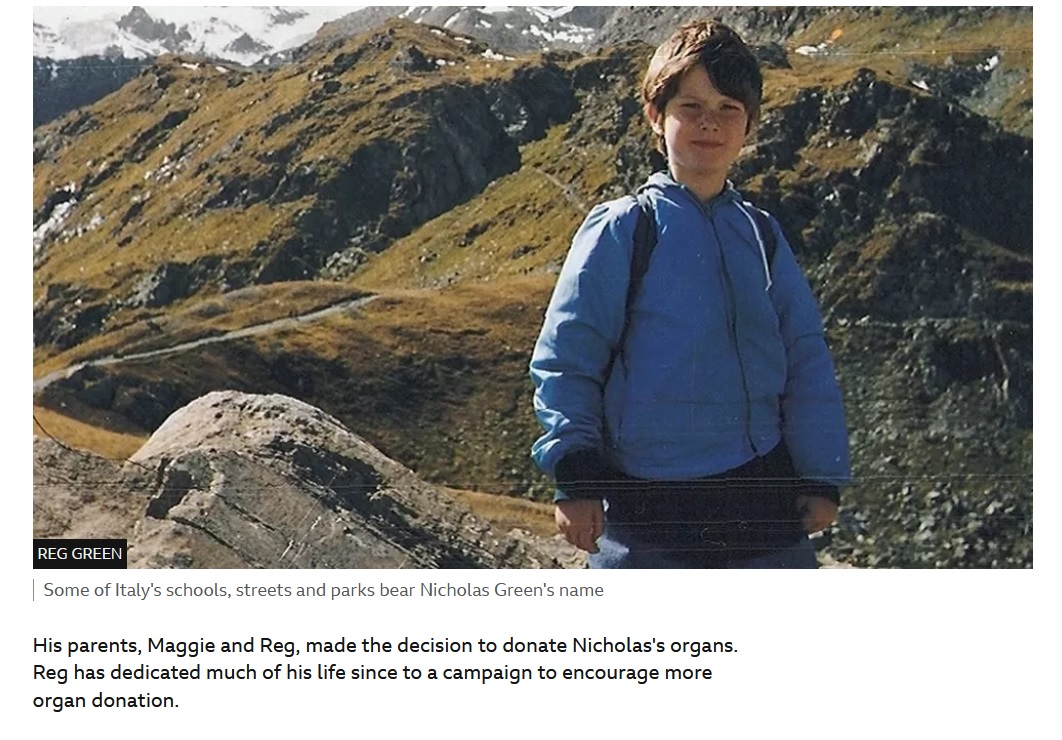
The seven-year-old was on holiday in Italy with his family in September 1994 when the car he was travelling in was shot at in a suspected case of mistaken identity.

His parents, Maggie and Reg, made the decision to donate Nicholas’s organs. Reg has dedicated much of his life since to a campaign to encourage more organ donation. […..]

L’effetto Nicholas – the Nicholas effect – is clear to see. The hope is that a similar transformation will take place in India.

At the forefront of this is Dr Deepak Gupta, who has travelled to Rome to meet Reg and other experts from the organ donation community. It was Dr Gupta who first spoke about the option of organ donation to Rolly’s parents – they, like many in the country, had never heard of it. He used Nicholas’s example to show Mr Prajapati, the possible impact of donating. One person dies in India from a head injury every three minutes, according to the Lancet Neurology Commission, and so, Dr Gupta says, there is “a lot of potential for donors”

BBC Article - Harry Low - January 2023 - 3

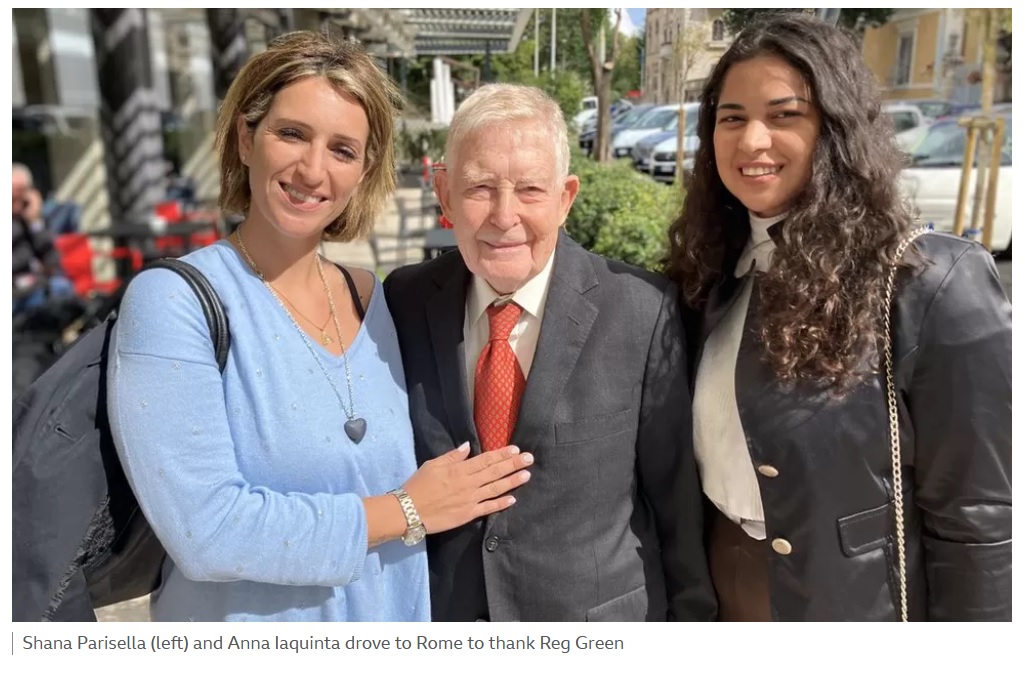
Each time Reg, 94, returns to Italy from his home in Los Angeles, he meets some of Nicholas’s recipients – on this trip, he met two women bound together by the transformative effect of donation.

Shana Parisella’s brother Davide was killed in a car crash in March 2013, and his heart was transplanted to Anna Iaquinta. Nine years after the operation, Anna decided to search for her donor’s family and formed a strong bond with Shana, who she says is like a sister to her.

Shana, who has driven 140 km. from Fondi to Rome, said it was a dream to meet a “great man” who was “an example for everyone”.

Anna said: “It’s not easy for the person that receives the heart because you have a lot of thoughts and you kind of feel bad because on their side there’s a lot of pain. But on your side there’s a lot of joy, so it’s kind of like two different emotions.” […..] “Nothing will ever be enough for having received life.” […..]

After visiting Rome, Reg travelled to Messina where he met 24-year-old Nicholas, the son of Maria Pia Pedala who was in a coma when she received Nicholas’s liver 29 years ago. He says he will only stop speaking about the issue when he dies. “I’m 94 years old so I was quite old when I started this,” he told the BBC.

“I think by now I would have hung up my tonsils but the thought that just by talking you can save lives has been a thought that motivates me every day.”


Link to the complete article: https://www.bbc.com/news/world-asia-india-62987703

Twitter BBC: https://twitter.com/BBCWorld/status/1620237444250468352

Twitter Harry Low: https://twitter.com/harrylow49/status/1620924625957060608 

Leave a comment

Filed under In the news, Italia, Italy, The Nicholas Effect, Useful tools

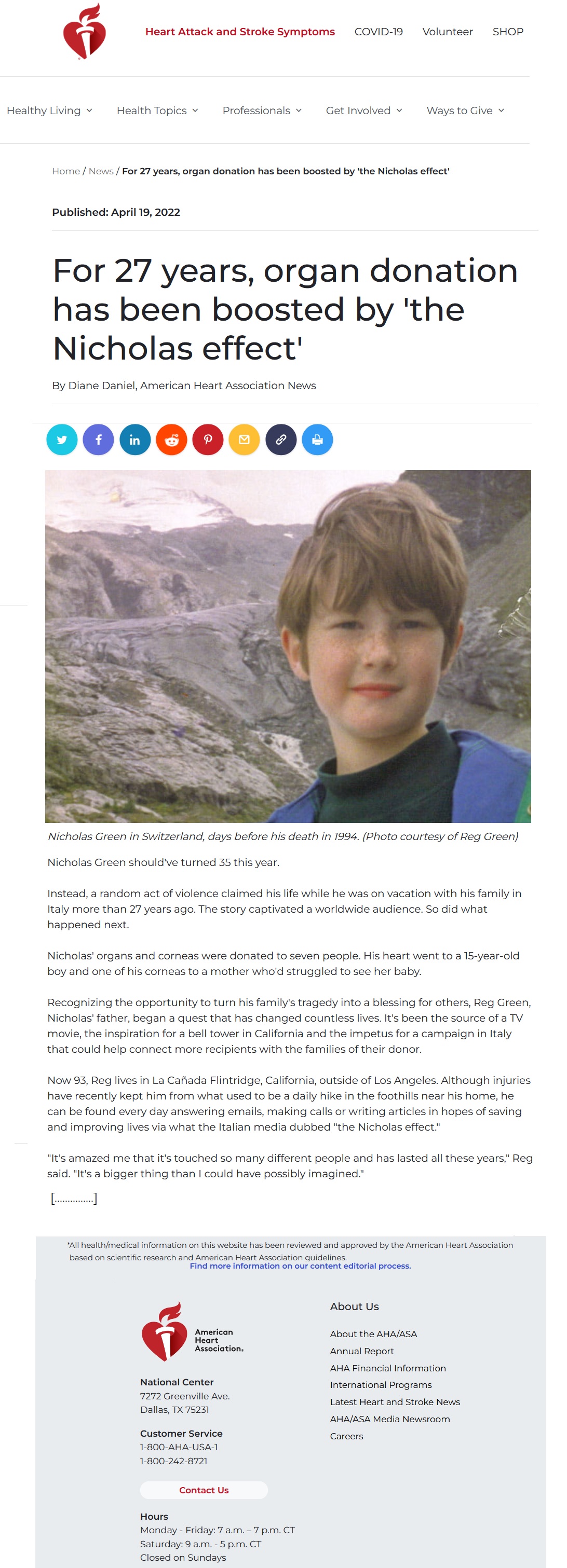
“For 27 years, organ donation has been boosted by ‘the Nicholas effect'”

By Diane Daniel, American Heart Association News

Link to the article, AHA website: https://www.heart.org/en/news/2022/04/19/for-27-years-organ-donation-has-been-boosted-by-the-nicholas-effect


     Nicholas Green should’ve turned 35 this year.

Instead, a random act of violence claimed his life while he was on vacation with his family in Italy more than 27 years ago. The story captivated a worldwide audience. So did what happened next.

Nicholas’ organs and corneas were donated to seven people. His heart went to a 15-year-old boy and one of his corneas to a mother who’d struggled to see her baby.

Recognizing the opportunity to turn his family’s tragedy into a blessing for others, Reg Green, Nicholas’ father, began a quest that has changed countless lives. It’s been the source of a TV movie, the inspiration for a bell tower in California and the impetus for a campaign in Italy that could help connect more recipients with the families of their donor.

Now 93, Reg lives in La Cañada Flintridge, California, outside of Los Angeles. Although injuries have recently kept him from what used to be a daily hike in the foothills near his home, he can be found every day answering emails, making calls or writing articles in hopes of saving and improving lives via what the Italian media dubbed “the Nicholas effect.”

“It’s amazed me that it’s touched so many different people and has lasted all these years,” Reg said. “It’s a bigger thing than I could have possibly imagined.”

AHA ARTICLE April 2022

Screenshot of AHA article

The story begins in September 1994, when Reg and Maggie Green were driving on a highway in Italy. Their children, 7-year-old Nicholas and 4-year-old Eleanor, were asleep in the back seat of the family’s rental car.

Thieves thought their car was carrying jewels. They shot through the back window. Only one bullet hit any of them. It lodged at the base of Nicholas’ brain.

Over the next two days, doctors at a hospital in Sicily tried saving the boy. Meanwhile, the sensational story – a young American shot by highway robbers in Italy because of a case of mistaken identity – rapidly generated headlines throughout the country and beyond.

When doctors declared Nicholas brain-dead, Italians poured out their grief, from people on the street to the prime minister.

Maggie and Reg decided to donate Nicholas’ organs and corneas. They went to four teenagers and three adults.

If one little body could do all that, Reg thought, imagine how many could be helped if more people became organ donors?

“I knew we’d been handed an opportunity,” said Reg, who had earlier worked as a journalist in London and was then writing a financial newsletter. “I saw this as the biggest news story of my life. We had the chance to change the direction of organ donation.”

Back home in California’s Bay Area, Reg and Maggie established The Nicholas Green Foundation to support organ and tissue donation worldwide.

In Italy, the impact “was almost instantaneous,” Reg said. “Donation rates went up 30% in the fourth quarter of 1994 and rose every year for the next 10 years until they were triple what they had been before he was killed.”

Reg was soon giving interviews and publishing opinion articles in countries as diverse as India, Australia and Venezuela. He and Maggie started traveling anywhere they were invited to promote their cause. (Maggie stopped traveling as much in 1996, when she and Reg had twins, Laura and Martin.)

“People around the world were realizing, some for the first time, the power of organ donation,” Reg said.

The momentum took many forms.

In 1995, sculptor Bruce Hasson volunteered to build a bell tower dedicated to children who have died. Italians donated more than 140 bells, with the centerpiece blessed by Pope John Paul II. (In 2018, Nicolas’ sister Eleanor was married at the site of the sculpture.)

In 1998, the TV movie “Nicholas’ Gift” aired, starring Jamie Lee Curtis. Earlier this year, Curtis posted on social media a remembrance of “the privilege of portraying Maggie Green” and cited the Nicholas effect. She called organ donation “honoring, humbling and haunting.”

In the early days of the nonprofit, Reg received a letter from a 21-year-old university student in Rome named Andrea Scarabelli. He wanted to help.

Scarabelli began translating articles published in Italy into English for the Greens. He later translated Reg’s books, articles and speeches into Italian and even arranged media tours all over Italy.

“Reg and Maggie really changed the attitude of a nation,” Scarabelli said. “Now organ donation is seen as a normal thing in Italy.”

When Nicholas’ organs were donated, the Greens were tremendously moved by getting to meet the recipients. One recipient was a 19-year-old woman who nearly died the same night as the boy; she’s now the mother of two, including a boy she named Nicholas.

However, laws in Italy changed, no longer facilitating contact between organ recipients and their donor’s family. Starting in 2016, Reg and Scarabelli began pushing to give donors and recipients opportunities to meet. A bill to that effect has been introduced by a group of legislators.

Maggie praised her husband’s tireless efforts.

“I’m a willing participant, but he’s always been the engine,” she said.

Maggie said that while her family has celebrated the life and grieved the death of Nicholas with the world, they have their private remembrances as well.

“People outside the family remember the day he died,” she said. “We remember his birthday.”


1 Comment

Filed under American Heart Association (AHA), In the news, Nicholas' story, Useful tools

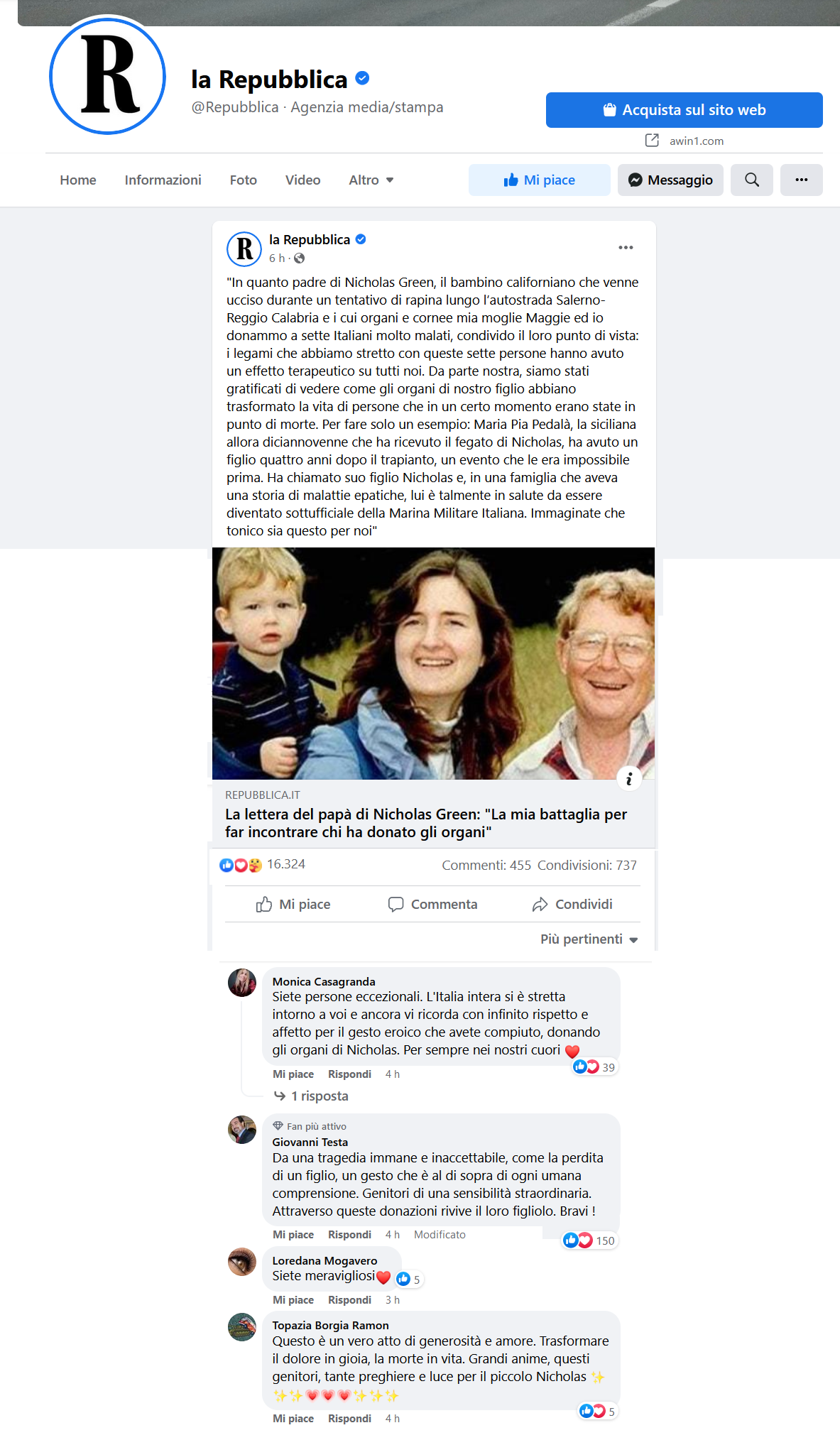
The letter from the father of Nicholas Green: “My battle to allow contacts between the two sides in organ donation”

(Article by Reg Green published in ‘La Repubblica’, an Italian national newspaper. March 3, 2022)

When Dan and Shirley Mason. an American couple, met Inger Jessen, who when 55 years old had received the heart of their 18-year old daughter, Nicole, it was one of the most meaningful events of their lives. They all hugged, cried with joy and exchanged stories. They have become close friends.

The dramatic culmination of their first meeting was when the Masons heard through a stethoscope the steady beat of their daughter’s heart. “I couldn’t believe it,” Dan said later.  “Since Nikki was killed in a car accident twenty years ago, I think of her every day. She seems so far away. But here she was again.” Inger too was profoundly moved. “Since then,” she says, “I have felt a peace I haven’t known in years.”

     As the father of Nicholas Green, the seven-year old California boy who was shot in an attempted robbery on the Salerno to Reggio Calabria autostrada and whose organs and corneas my wife, Maggie, and I donated to seven very sick Italians, I share their view: the bonds we have forged with those seven have had a healing effect on all of us.

     On our side, we have been gratified to see how our son’s organs have transformed life for people who were once on the brink of death. To give just one example: Maria Pia Pedalà, the 19-year old Sicilian who received Nicholas’ liver had a baby four years after the transplant — an impossible happening beforehand. She called the baby Nicholas and in a family with a history of liver disease he is fit enough to have become a non-commissioned officer in the navy.

    On their side, the recipients can see we don’t hold it against them that they are living only because our son died — and that has freed them from the sense of guilt that many recipients carry with them for the rest their lives. Twenty-seven years after the transplants, five of the seven are still alive.

   But communication between organ donor families and their recipients is almost impossible in Italy under a law (91/99) that was passed more than twenty years ago because lawmakers feared that any contact, even if both sides want it, risks psychological damage. Even anonymous letters are forbidden!

     In the United States, however, tens of thousands of families have either met face to face or have written to each other and in the overwhelming majority of cases the happiness and health of both sides have improved. In fact every one of the 58 organ procurement organizations in the United States, that under the Department of Health look after both donors and recipients, encourages contact.

La Repubblica Facebook post - March 12 2022

The article had more than 16,000 likes on the Facebook page of the newspaper

     Of course, these contacts are planned in conjunction with the families’ medical advisers: finding each other through the Internet, as some Italian families do, is asking for trouble. Contact usually begins when one side writes anonymously to their transplant team, who scrutinize it to make sure there is no sign of risk, such as an overwrought family or one likely to make emotional demands on the other side. If the family receiving the letter does not want to write back, communication stops cold. If they want to reply, however, they do so, also anonymously, and the first family also has the option of continuing or breaking off the conversation there and then. After a while, however, both sides can reveal their identity if they wish and share their experiences as many thousands have.

     The result of all this care is that none of the morbid forecasts of things going wrong has happened on any scale. For example, I couldn’t uncover one case in America of a donor asking a recipient for money. Instead, imagine the thrill we had when a cousin of the 15-year old who received Nicholas’ heart told us that after the transplant he said to everyone he met, “I used to have a worn-out old jalopy for a heart. Now I have a Ferrari.”

     To this day in Italy when those who oppose liberalization are asked for proof of any significant numbers of things going wrong they are unable to provide them. Can things go wrong? Of course. But the thousands and thousands of medically documented cases where things went well in the US are evidence that the problems are extremely rare. I challenge opponents of change to show any statistics of problems.

     Despite all this, when I, with just one helper, Andrea Scarabelli in Rome, started a campaign in 2016 to liberalize contacts between the two sides in Italy we were so alone that we became known as Don Quixote and Sancho Panza. But we sent the evidence we collected to every national organization involved in transplantation and, after studying it, all of them — the National Transplantation Center, the National Bioethics Committee and the National Institute of Health — have come out in favor of contact when it is done under authorized medical supervision and when both sides have clearly expressed a desire for it. Dr Pierpaolo Sileri, Deputy Minister of Health, has said firmly, “La liberalizzazione dei contatti tra riceventi e donatori è un gesto di umanità e civiltà, un atto doveroso”. I hope readers of this article will support the legislation that has been introduced to allow that to happen and relieve a lot of unhappiness in families who have performed one of the most selfless acts our society knows.

(Link to the article in Italian: https://www.repubblica.it/cronaca/2022/03/03/news/la_lettera_del_papa_di_nicholas_green_la_mia_battaglia_per_far_incontrare_chi_ha_donato_gli_organi-340120452/)

Author: Reg Green.

Leave a comment

Filed under In the news, Italia, Italy, Nicholas' story, Stories, Useful tools

Their Favorite Murder

Would you believe it? There’s a podcast called “My Favorite Murder” — and it is the sixth most-listened to podcast out of the thousands available. It focuses on true crime stories and the title, of course, is a way to catch attention: it evidently succeeds because Wikipedia estimates that last year it had 25 million downloads a month!

Recently they did a 13-minute segment on the killing of Nicholas and, despite the show’s title, they dealt with it responsibly and, except for some details, accurately.

screenshot podcast nicholas

They even asked listeners who had an interesting organ donation story to tell to contact them at myfavoritemurder@gmail.com. Write to them if you have such a story. If they use it you will have a huge audience, most of whom have never thought seriously about organ donation.

Here is the link:  https://myfavoritemurder.com/318-one-spiritual-moment/. Our story begins at the 17th minute (I’d skip the chit chat that goes on until then) and ends at the 30th.

Reg Green

Leave a comment

Filed under In the news, Nicholas' story, Stories

Canada’s “Most Tenacious Donor Advocate”

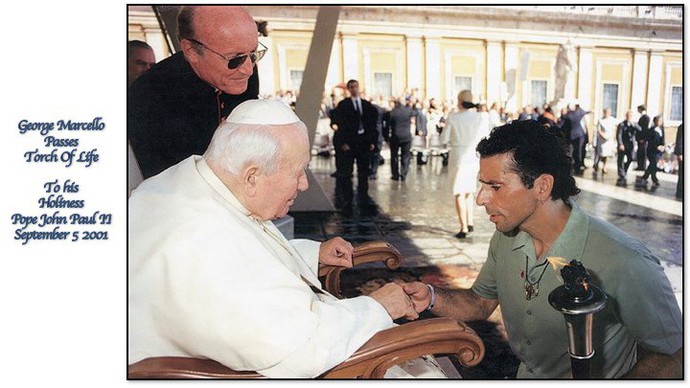
George Marcello, Canada’s most tenacious advocate for organ donation, has died aged 65, after a long illness made worse by his refusal to slow his relentless campaign to raise awareness of the worldwide shortage of donated organs. In the 27 years that I have been traveling the world for the same cause, I have never met anyone who gave more of himself to organ donation. Working mostly alone, he took up the cause when his own life was saved in 1997 by a donated liver. He walked thousands of miles across  Canada carrying a torch — the Torch of Life, he called it — attracting a following in whatever community, large and small, he walked through. One of those who wanted to know more was Pope John Paul II who blessed the torch when he gave an audience to George in Rome in 2001. 

George Marcello

                             (Photo by ‘Step by Step Organ Transplant Association’)

Among his many initiatives was bringing together the family of Palestinans, whose son was shot by mistake by an Israeli soldier and whose organs went to Israeli children, and the mother of a British Jew who was blown up by a Palestinian terrorist, one of whose kidneys went to a Palestinian. I don’t know anyone else who would have thought of that powerful lesson for humanity and had the iron determination to make it happen.

For more please see https://www.canadahelps.org/en/charities/step-by-step-organ-transplant-association/ 

Leave a comment

Filed under In the news, Stories, Uncategorized

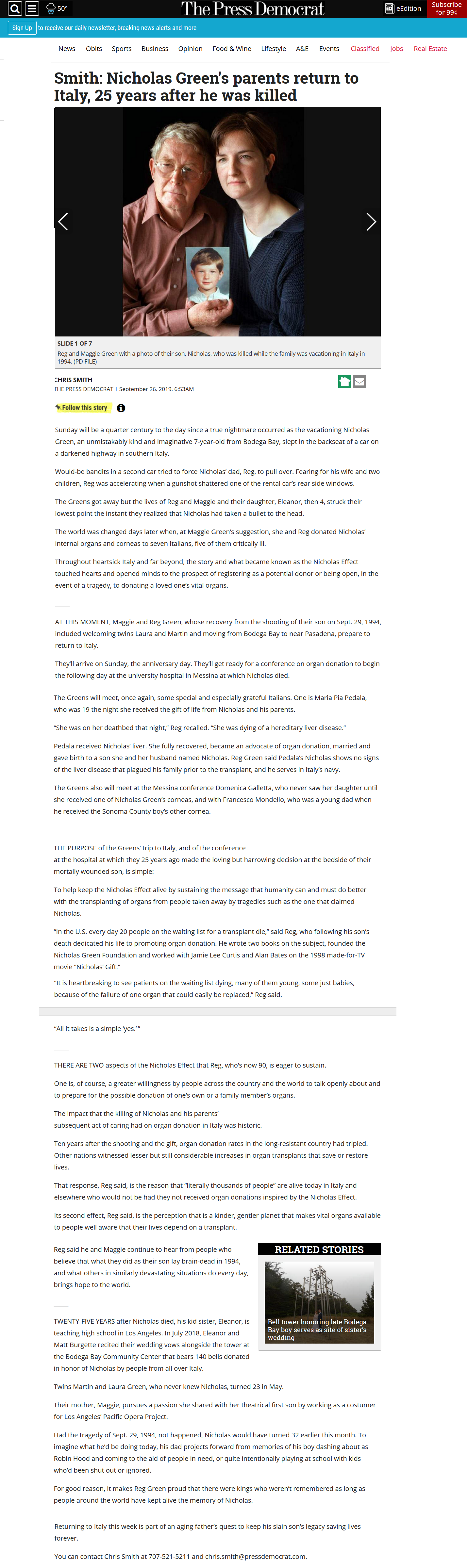
25th Anniversary of Nicholas death and Donation. An article on the Santa Rosa Press Democrat

Article by Chris Smith  – September 26, 2019 – Santa Rosa Press Democrat

Link to the article: https://www.pressdemocrat.com/news/10096291-181/smith-25-years-after-nicholas?artslide=0&sba=AAS

Leave a comment

Filed under Events, In the news, Italia, Italy, Nicholas' story

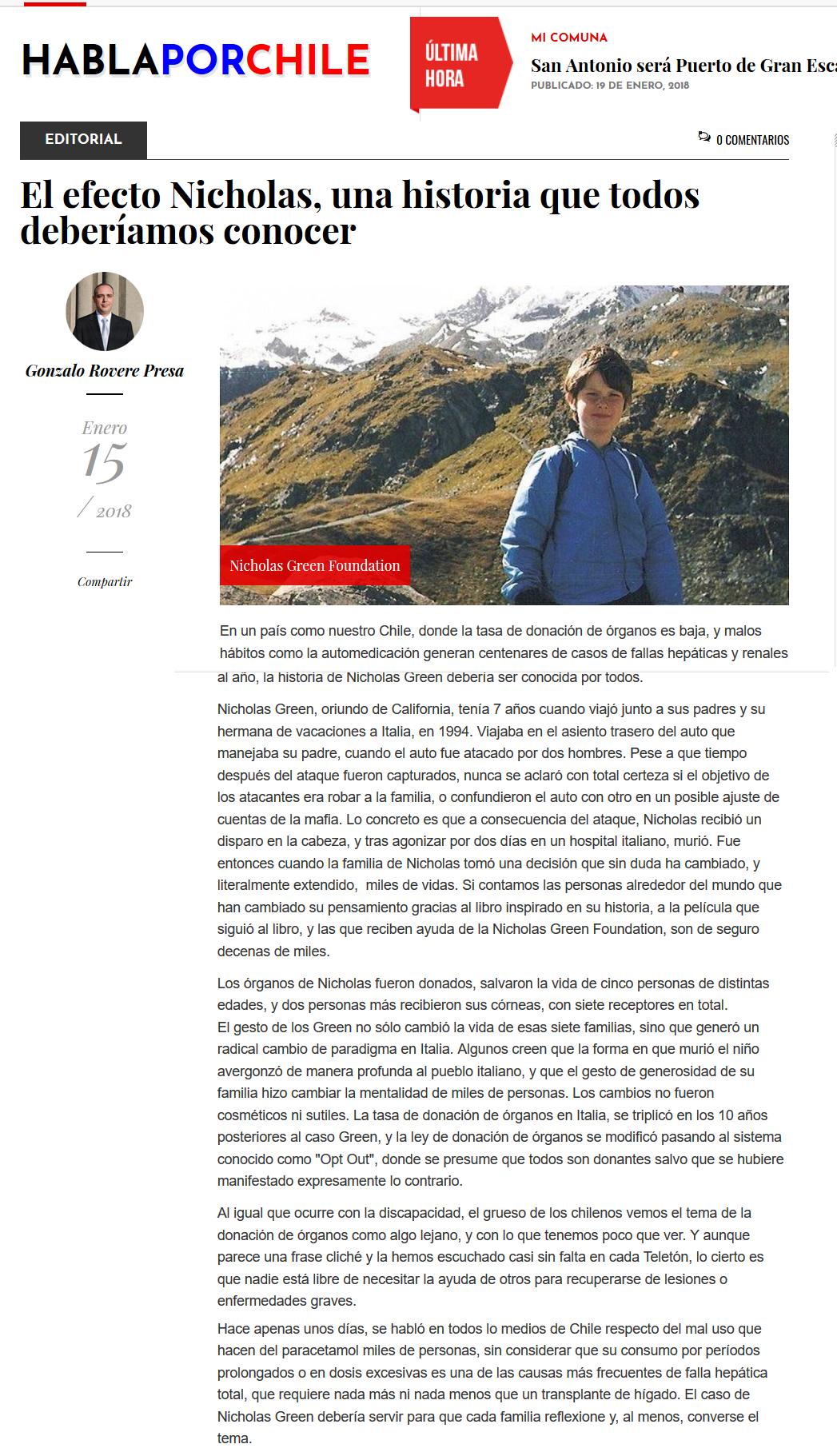
An Article from Chile: “The Nicholas Effect, A Story All People Should Know”

Leave a comment

August 4, 2019 · 2:14 am

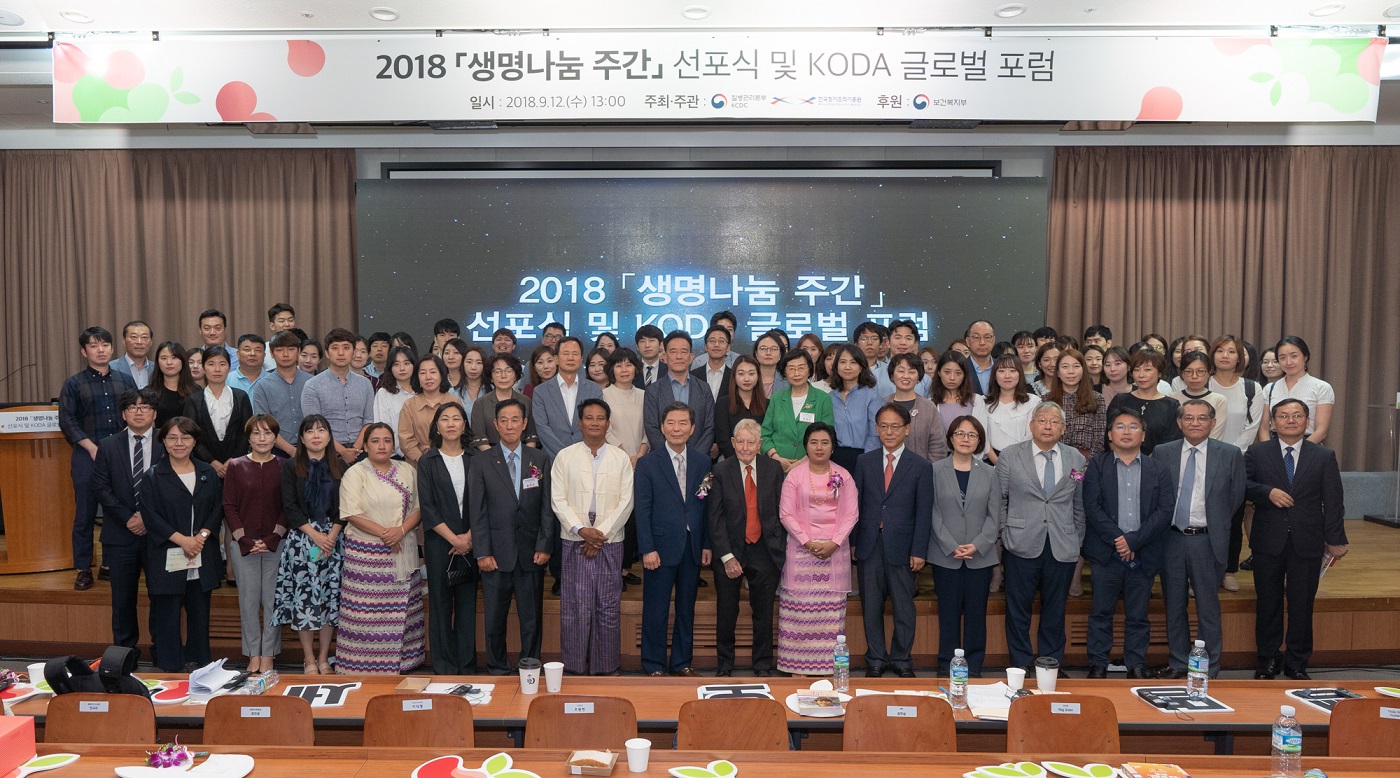
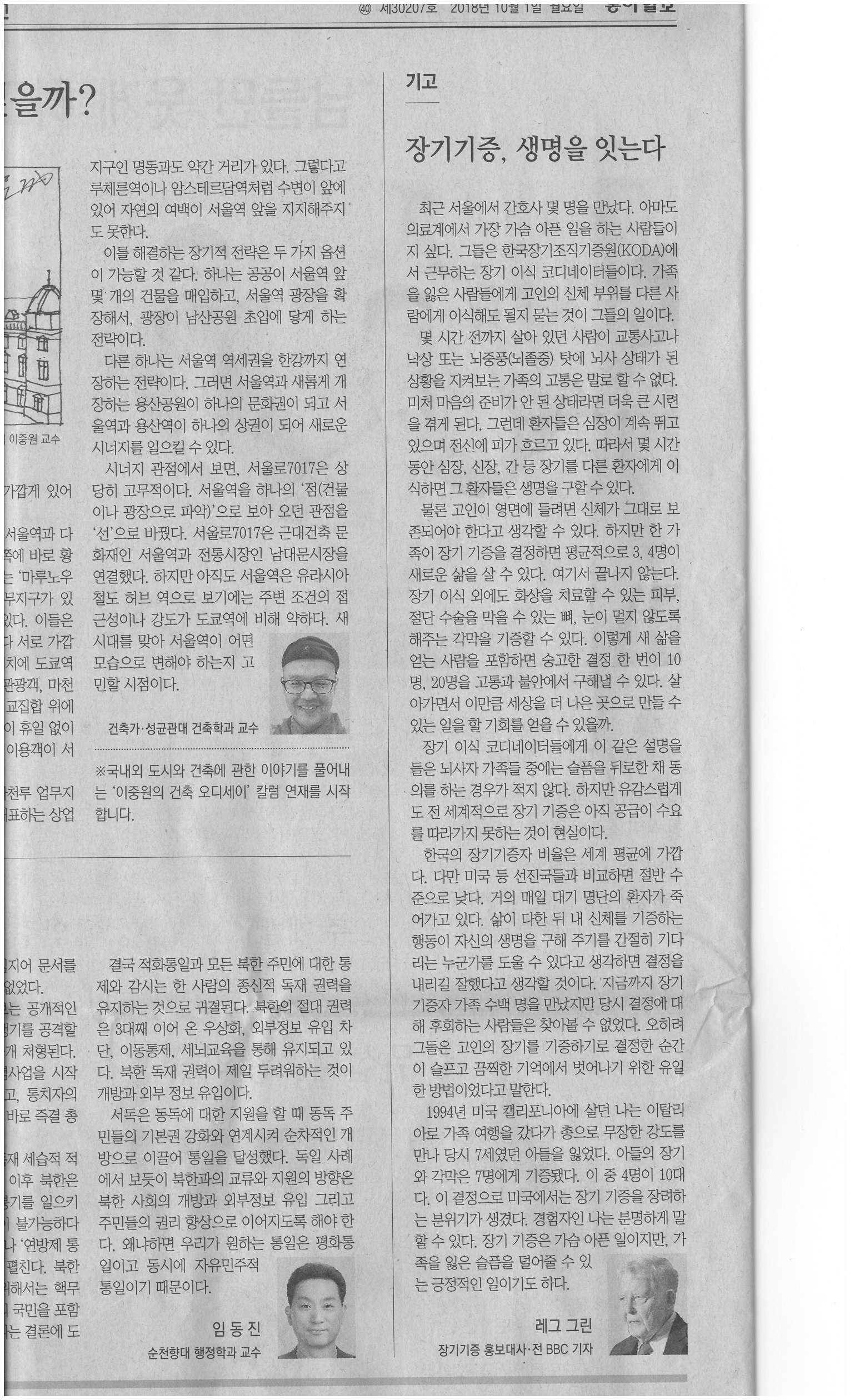
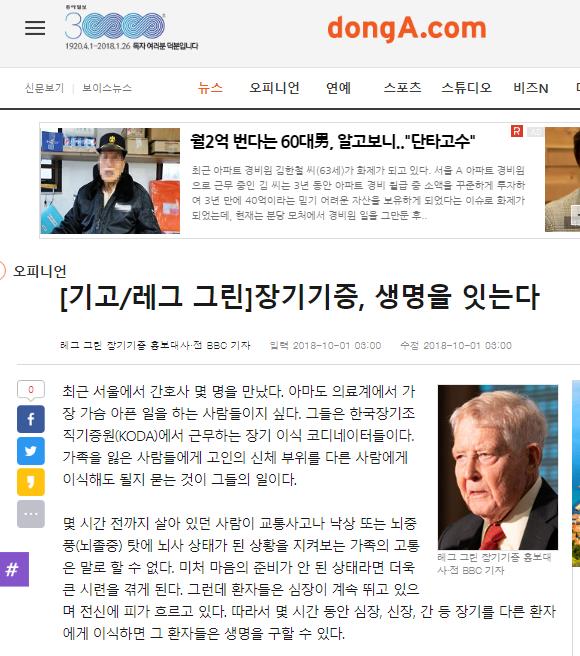
Article and photos from 2018 KODA conference in Seul, South Korea

September 2018 – Speech and conference at the 2018 KODA (Korea Organ Donation Agency) Global Forum


Leave a comment

Filed under Events, In the news